Don't Give Up the Upstairs. Or Outside.
When stairs become a daily problem, the choice is move, modify, or live on one floor. SAW is the mobility device that helps you climb stairs, with a caregiver right beside you.
Don't Give Up the Upstairs. Or Outside.
When stairs become a daily problem, the choice is move, modify, or live on one floor. SAW is the mobility device that helps you climb stairs, with a caregiver right beside you.

Invented by a Doctor of Physical Therapy

4 USPTO utility patents

1-year limited warranty
Stairs shouldn't decide where you live.
You've been at this longer than most. Through diagnosis. Through the changes. Through every workaround that almost worked.
Now the conversation has shifted. Move to a single-story house. Build an addition. Live on the first floor only. For some, leave their home entirely.
Those aren't choices. They're giving up a large part of your life.
SAW helps you stay in your home. Keep going outside.
Stairlifts are expensive. Canes and walkers weren't built for stairs.
Stairlifts cost $2,000 to $8,000 and need an environmental assessment, professional installation, and some homes aren't suitable. And they only fix one staircase, the one inside. Your front steps, your friend's house, your doctor's office, still there.
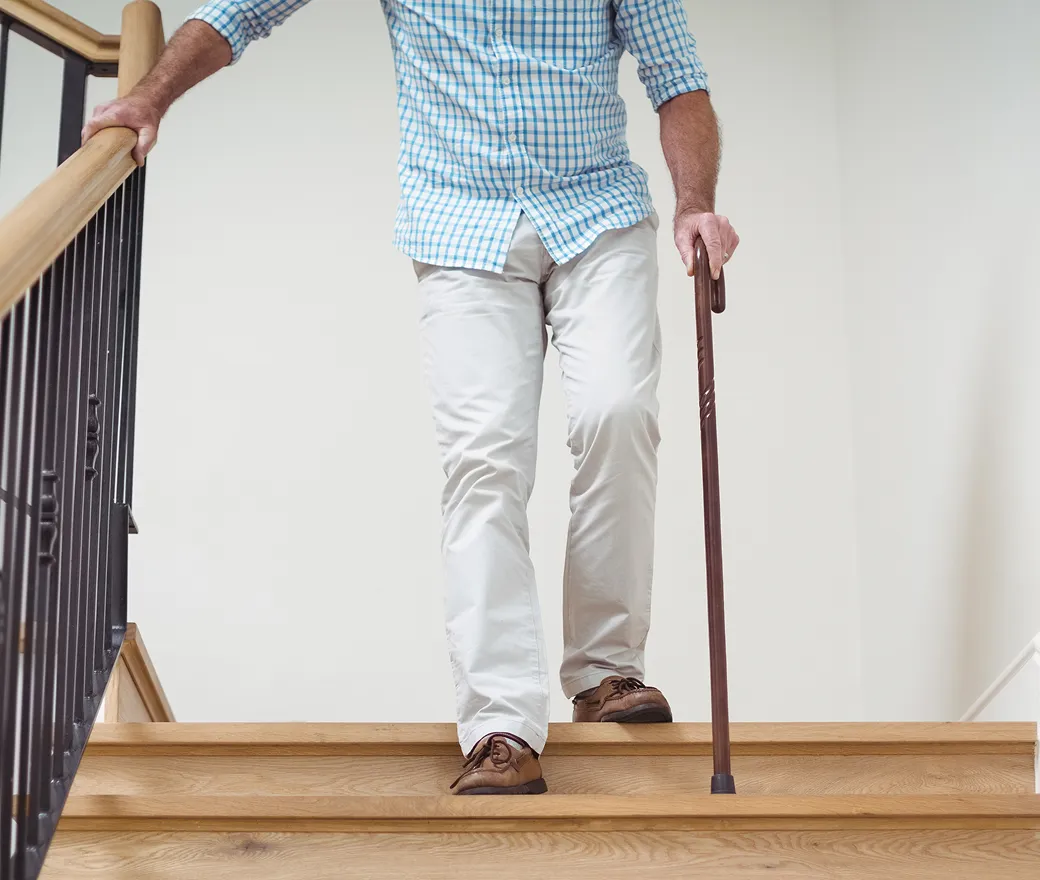
Canes weren't built to help the most functionally impaired people perform stairs. Standard walkers, rolling walkers or rollators weren't built for stairs either.
Every workaround leaves something out. Cost. Safety. Dignity. Usually all three.
SAW is a stair mobility device and a rolling walker in one.
On flat ground, SAW is a rolling walker. You use it like any walker you've had.
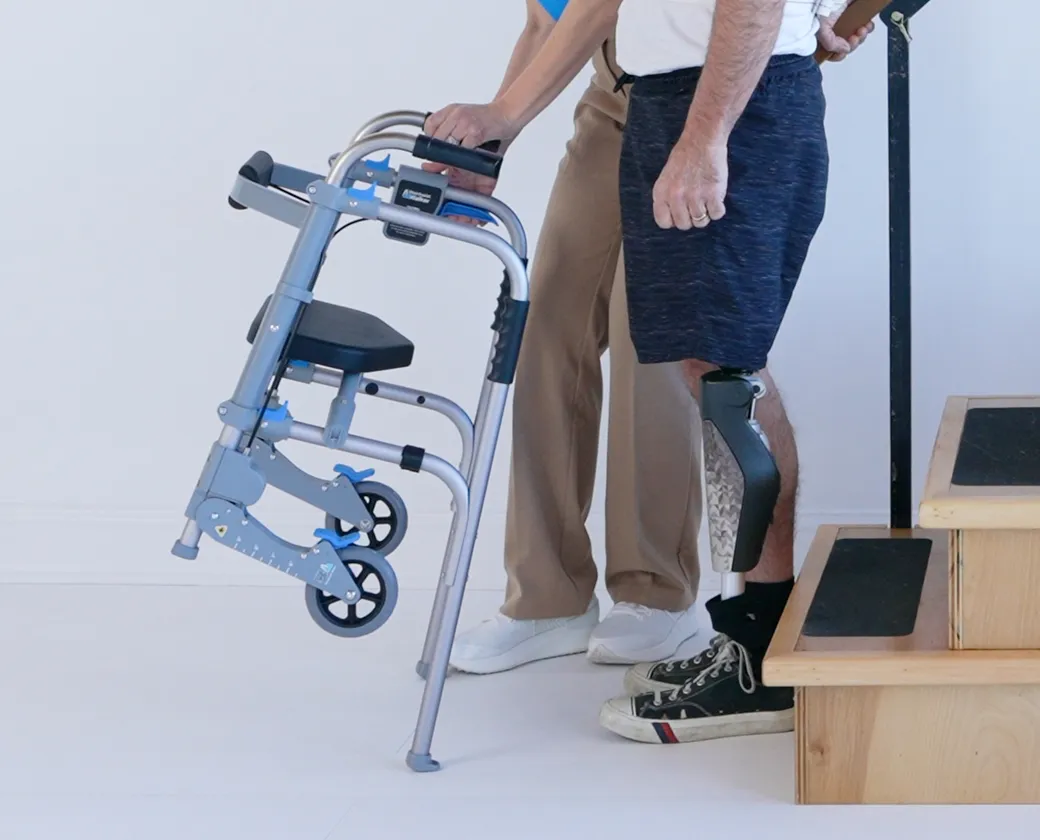
At the stairs, your caregiver converts it. The wheels come up. The stair legs are exposed. A few adjustments and you're ready.
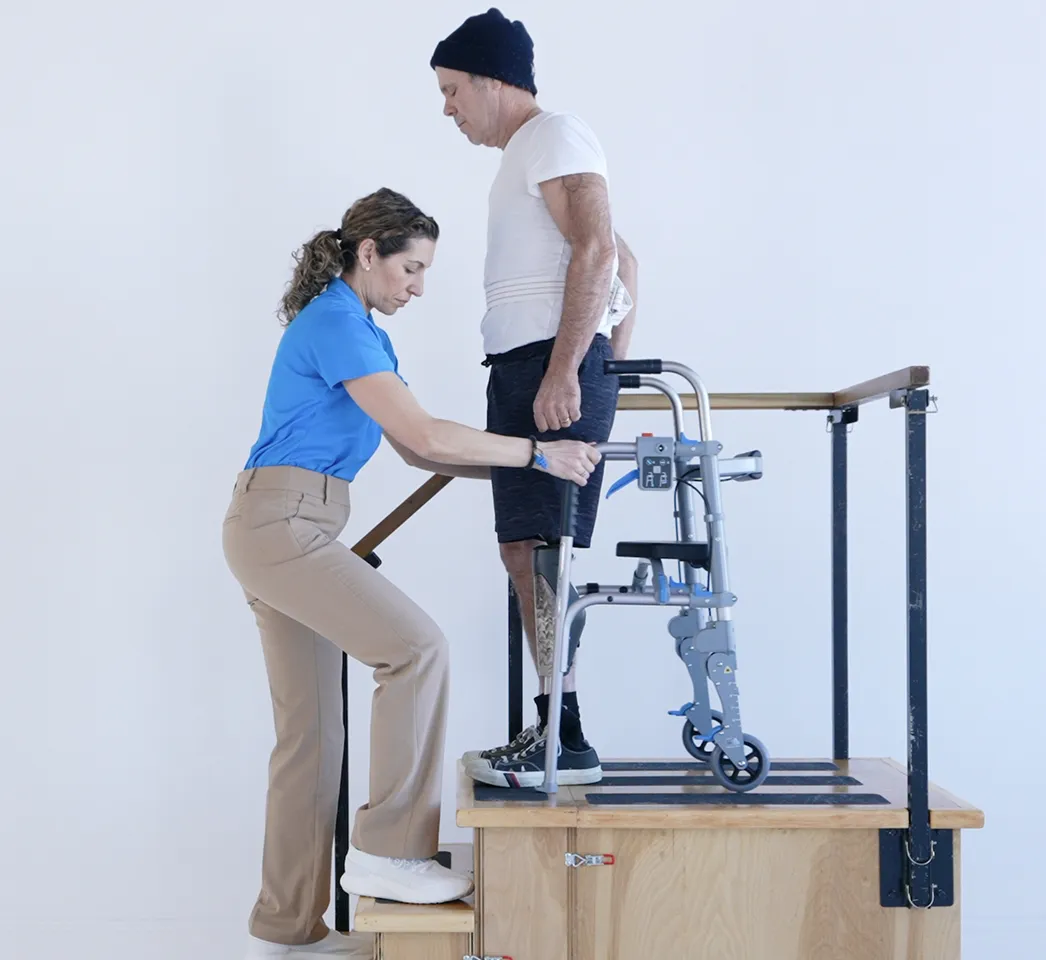
You sit, step, stand, sit again. Once per stair, up or down. Your caregiver stays one step below you, hands on a gait belt and a Caregiver Grip, the whole way.
A stairlift fixes one staircase. SAW comes with you everywhere else. Adjustable to almost any stairs. Front steps. Garage. Doctor's office. A friend's house.
One handrail, a gait belt, and a SAW Certified™ Caregiver guiding on every stair is required.
Built for the conditions that make stairs hard.
Multiple sclerosis
MS makes stairs unpredictable. Fatigue, balance, leg weakness that shifts day to day. SAW gives you a seat on every step, so a hard day doesn't turn into a day stuck on one floor. Used with your caregiver, the whole way.
Parkinson's
Freezing, balance changes, the hesitation that makes a staircase feel like a gamble. SAW lets you sit, step, and stand one stair at a time, at your pace, with your caregiver guiding every step.
Stroke recovery
After a stroke, one side often carries what the other can't. Stairs ask both to cooperate. SAW shares the load. You sit between every step, your stronger side does what it can, your caregiver does the rest.
Lower limb loss
After lower limb loss, even with a prosthetic, the balance and push-off on stairs can take the longest to relearn. SAW lets you sit between every step, so the stairs don't ask for all of it at once. Used with your caregiver and a gait belt.
COMPARED TO THE ALTERNATIVES
The four ways families try to handle stairs.
SAW is for the families who want their stairs back without rebuilding their house.
HOW BUYING SAW WORKS
Five steps. We don't ship until your caregiver is certified.
The IFU requires a certified caregiver. We built buying SAW so your patient qualifies and your caregiver is certified before you pay the full price.
STEP 1

Start your order.
Tell us where to send your information. No commitment yet.
STEP 2

Make sure SAW is right for your patient.
A short qualification covering patient criteria, caregiver criteria, and your home staircase. You'll know if SAW is a fit before you pay anything.
STEP 3

Reserve your SAW with a refundable deposit.
$199 holds your order. Your caregiver completes certification next, then your balance unlocks.
STEP 4

Your caregiver gets certified.
Our Certification ensures safe and proper use. The Certification takes about 30 minutes and includes video tutorials, written lessons, and quizzes. It's sent as a part of your order, or get access on the Caregiver page.
STEP 5

Pay the balance. We ship your SAW.
Once your caregiver is certified, the $950 balance unlocks. Your SAW ships ready to use, no assembly required.
HSA and FSA eligible.
If your caregiver doesn't pass, we'll set up a call to assess. Switch caregivers, find a professional, or refund your deposit. Your $199 is yours until the moment we ship.
Anyone can become a SAW Certified™ Caregiver.
A caregiver can be a relative, partner, friend, neighbor, or licensed professional. Whoever's there with you on the stairs.
Many people living with chronic conditions already have a professional caregiver, an HHA, a CNA, the home-health team that comes by. They can be the caregiver. So can your spouse, your adult child, or a neighbor who's offered.
Every caregiver completes SAW certification before use. Video tutorials, written lessons, and quizzes. About 30 minutes, done online. So whoever's helping you is trained the moment SAW arrives.
More about caregiver certification →You'll know in 4 questions.
Four yeses is a good sign. The full qualification covers a few more items, including your caregiver setup and the dimensions of your stairs.
5-minute qualification. Covers your situation, your caregiver, and your stair dimensions. No payment until you qualify. Every SAW order starts here.
See if SAW Is a FitQuestions people ask.
Common questions before ordering SAW for long-term, chronic-condition use. For general product questions, see the full FAQ.
SAW is built around sitting between every step, so the stairs don't ask you to push through all at once. Your caregiver shares the work, with a gait belt and one handrail, every step. If a day feels too unsteady, you and your caregiver can wait until the next one. SAW doesn't ask you to push through what your body's telling you.
Either works. Anyone who's there with you on the stairs can be the caregiver: a spouse, an adult child, a friend, a neighbor, or a licensed professional. If you already have a professional caregiver (HHA, CNA, home-health team), they can be the caregiver. Every caregiver completes SAW certification before use, about 30 minutes, online.
Your $199 deposit is refundable. If the patient qualification shows SAW isn't right for you, we refund the deposit and point you to alternatives we know of. Your $199 is yours until the moment we ship.
Your $199 deposit is refundable. If the patient qualification shows SAW isn’t right for your parent, we refund the deposit and point you to alternatives we know of. Your $199 is yours until the moment we ship.
Stairlifts cost $2,000 to $8,000, require a contractor, and only fix one staircase. The SAW device is $1,149, plus shipping and applicable sales tax. It comes to your door and works on any indoor or outdoor stairs within a 6 to 9 inch rise. SAW also folds, so it travels with them. To the doctor’s office, a friend’s house, anywhere they need to go. Stairlifts solve one staircase. SAW solves all the stairs in their day.
Most standard residential stairs work. 6 to 9 inch rise, 9.5 inch run or deeper. Carpet is fine. SAW needs at least one handrail on the staircase (per the IFU). Narrow or unusually steep stairs may not fit. The qualification quiz covers exact dimensions. If your stairs don’t qualify, we refund the deposit.
Generally no. CMS classifies stair mobility devices as a "convenience item," so Medicare and most private insurance plans don't cover SAW. Veterans Affairs grants, Medicaid waivers, specific Medicare Advantage supplemental plans, and workers' compensation may cover SAW case by case, but we can't promise coverage. Ask your provider directly. SAW is HSA and FSA eligible.
Keep your home. Keep your life.
Your appointments. Your friends. Your family. Your bedroom. Your bathroom. The upstairs. SAW comes to your door. The device is $1,149, plus shipping and applicable sales tax. No installation. No prescription. No contractor. Use the home you have.