
NEXT STEP IN MOBILITY™
The Stair Walker, Built for Home.
Aging. Recovery. Chronic conditions. No one should have to choose between their safety and the rest of their home. SAW is the walker that climbs stairs, with a caregiver right beside you.
$1,149
$199 refundable deposit today
$950 balance, charged after your caregiver is certified
HSA and FSA eligible.
We don't ship until your caregiver passes the certification.

Invented by a Doctor of Physical Therapy

4 USPTO utility patents

1-year limited warranty
Stairs have always been the problem.
Stairlifts cost $2,000 to $8,000 and need an environmental assessment, professional installation, and some homes aren't suitable. Canes weren't built to help the most functionally impaired people perform stairs. Standard walkers, rolling walkers or rollators weren't built for stairs either.
Stairs become a hurdle. They start sleeping on the couch. Whole floors of the house go unused. People get sent home from rehab unable to reach their own bedroom.
We watched the gap for 16 years. So we built the answer.
Here’s how SAW works.
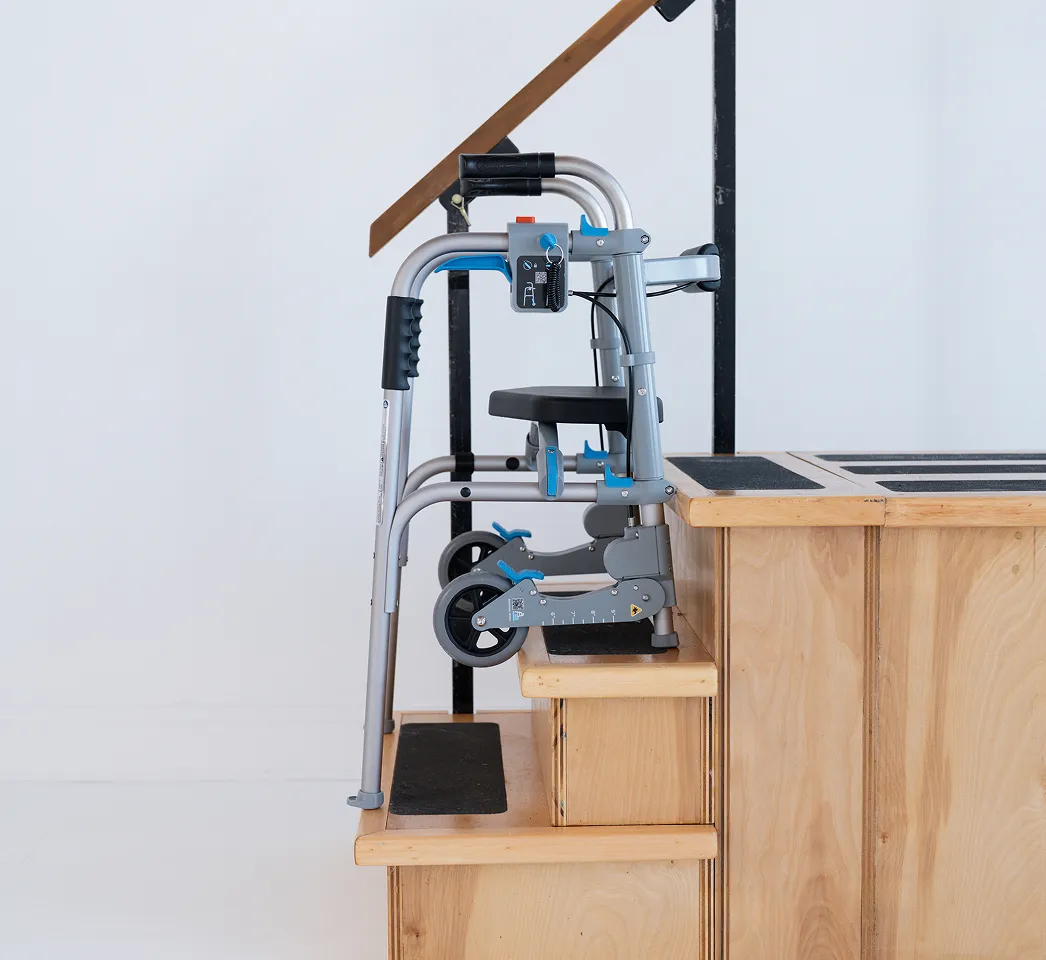
SAW converts between walker mode and stair mode. No installation. No electricity. No permanent changes to your home.
Walk.
On flat surfaces, SAW functions as a standard rolling walker with front wheels, a built-in seat, adjustable Patient Grips, and brakes.
Convert.
At the base of the stairs, the caregiver activates the Stair Mode Safety Lock. The wheels lift. The Stair Conversion Legs deploy. SAW is now in stair mode.
Climb.
Patient sits. Steps up with the stronger leg. Stands. Sits again. The caregiver repositions SAW one step at a time, right beside the patient the whole way up.

One handrail, a gait belt, and a SAW Certified™ Caregiver guiding on every stair is required.
HOW BUYING SAW WORKS
Five steps. We don't ship until your caregiver is certified.
The IFU requires a certified caregiver. We built buying SAW so your patient qualifies and your caregiver is certified before you pay the full price.
STEP 1

Start your order.
Tell us where to send your information. No commitment yet.
STEP 2

Make sure SAW is right for your patient.
A short qualification covering patient criteria, caregiver criteria, and your home staircase. You'll know if SAW is a fit before you pay anything.
STEP 3

Reserve your SAW with a refundable deposit.
$199 holds your order. Your caregiver completes certification next, then your balance unlocks.
STEP 4

Your caregiver gets certified.
Our Certification ensures safe and proper use. The Certification takes about 30 minutes and includes video tutorials, written lessons, and quizzes. It's sent as a part of your order, or get access on the Caregiver page.
STEP 5

Pay the balance. We ship your SAW.
Once your caregiver is certified, the $950 balance unlocks. Your SAW ships ready to use, no assembly required.
HSA and FSA eligible.
If your caregiver doesn't pass, we'll set up a call to assess. Switch caregivers, find a professional, or refund your deposit. Your $199 is yours until the moment we ship.
COMPARED TO THE ALTERNATIVES
The four ways families try to handle stairs.
SAW is for the families who want their stairs back without rebuilding their house.
Most families know in 4 questions.
Four yeses is a good sign. The full qualification covers a few more items,
including your role as the caregiver and the dimensions of their stairs.
Every SAW order starts here.
See if SAW Is a Fit5-minute qualification. Covers patient, caregiver, and stair dimensions. No payment until you qualify.
BUILT FOR THE TWO OF YOU
Become a SAW Certified™ Caregiver.
Daughter. Husband. Friend. Home health aide. Anyone who assists on stairs needs SAW certification. The course contains video tutorials, written lessons and quizzes, it takes about 30 minutes, and covers safe operation from the first stand to the last step.
Caregivers must be able to lift 35 pounds, be independently mobile, and not use a walker or cane themselves. If your first caregiver can't take it on, we'll help you find one who can, including a professional caregiver in your area if you need one.
Learn About Becoming a SAW CaregiverWHAT YOU GET
One device. Two modes.
Walker mode and stair mode.
What's in the box
• StairAssist Walker (model SAW-2500)
• 2 Stair Mode Safety Lock keys
• Gait belt
• Spare set of rear feet
• Allen wrench (for replacing rear feet)
• Quick-start guide and full Instructions for Use
Specs
• Weight: 14.64 lbs
• Patient height range: 5 feet 2 inches to 6 feet (1.575 m to 1.829 m)
• Max patient weight: 300 lbs (136 kg)
• Stair rise: 6 to 9 inches (15.2 to 22.9 cm)
• Stair run: 9.5 inches (24.1 cm) minimum
• Patient Grip height: 32 to 36 inches (81.3 to 91.5 cm)
• Folded depth: 11 inches
• Caregiver lift requirement: 35 lbs
WHY TRUST SAW
Designed by a Doctor of Physical Therapy.

Built to a medical-device standard.
Founded in 2017 by Josh Sigsworth, Doctor of Physical Therapy. 16 years in PT before that, watching patients improvise on stairs.

Tested with patients.
Clinical evaluations with multiple rehab hospitals. 18 of 20 patients completed the full protocol. Every principal investigator believed SAW would increase discharge rates and reduce readmissions.

4 USPTO utility patents.
3 USPTO utility patents covering the conversion mechanism, the safety lock, and the stair geometry that makes SAW work where other walkers don't.
Questions before you start.
SAW ships only once your patient qualifies and your caregiver is certified. A certified caregiver can be a friend, family member, neighbor, or VNA who passes the SAW Certified Caregiver™ Program. We make sure both happen before you pay the full price. It protects everyone, and it means you only pay once SAW can actually be used safely.
$199 refundable deposit. The $950 balance is charged only after your caregiver passes certification. The StairAssist Walker is $1,149.
Yes. Until balance payment, or any time you ask before then. Your $199 is yours until the moment we ship.
As fast as one day if your caregiver is ready. Certification takes about 30 minutes.
We'll schedule a call to assess what happened, suggest adjustments, switch caregivers, or arrange a professional caregiver in your area. Your deposit is refunded on request.
No. SAW is purchased directly. Clinicians can recommend SAW. No prescription is required.
No. CMS classifies stair DME as a "convenience item" and no insurance covers stair mobility devices in the U.S. SAW is HSA and FSA eligible.
Get out of your home and get every floor back.
Family events. Doctor appointments. Your bedroom. Your bathroom. The second floor. SAW is the rolling walker built for stairs. No installation. No prescription. Use the home you already have.